
PC gaming is about much more than installing a game and pressing Play. Choosing the right hardware, understanding performance, selecting a suitable monitor, upgrading an existing system, and deciding which software environment works best can all affect the experience.
That is where PC-focused gaming resources become useful.
EuroGamersOnline.com PC Gaming is the PC-focused section of EuroGamersOnline. The website also covers console gaming and gadgets, while its PC Gaming category brings together articles covering gaming PCs, PC hardware, performance, optimization, and different ways of playing games on a computer.
For someone building a gaming PC, upgrading an existing machine, or simply trying to understand PC gaming better, the category provides several useful starting points.
This guide explains what EuroGamersOnline PC Gaming covers, who it is useful for, and how to make better decisions when researching a gaming setup.
What Is EuroGamersOnline.com PC Gaming?
EuroGamersOnline.com PC Gaming is the dedicated PC section of EuroGamersOnline.
The website’s main navigation includes PC Gaming, Console Gaming, and Gadgets, giving PC gamers a dedicated place within the site’s wider gaming coverage.
The PC Gaming category is particularly relevant to readers interested in the practical side of playing games on a computer.
That can include questions such as:
- What kind of gaming PC do I need?
- Which components matter most?
- Should I build or buy a prebuilt?
- How can I improve gaming performance?
- What monitor matches my hardware?
- Is my current PC worth upgrading?
- Can I use Linux for gaming?
- Which software and drivers do I need?
These questions are connected. A graphics card cannot be evaluated separately from the monitor, processor, power supply, games, and resolution you plan to use.
That broader approach is what makes a PC Gaming resource useful.
What Can You Find in the EuroGamersOnline PC Gaming Section?
The category covers several different aspects of PC gaming rather than focusing exclusively on individual games.
The PC Gaming archive includes articles related to gaming PCs, PC hardware, performance, and gaming setups. Examples include guides around Linux gaming PCs, Intel Core i7 gaming systems, i9 gaming PCs, gaming PC and monitor bundles, and gaming PC optimization.
This gives readers different entry points depending on what they are trying to accomplish.
Someone buying their first PC may want to start with hardware and budget considerations. An experienced player may instead be interested in optimization or a particular component. Someone considering an alternative operating system can explore Linux gaming.
Gaming PC Guides
Buying a gaming PC is not simply a matter of choosing the largest numbers on a specification sheet.
A good system needs balanced components.
The graphics card is obviously important for modern games, especially when playing at higher resolutions or using demanding graphical settings. But the processor, memory, storage, cooling, motherboard, and power supply also contribute to the overall system.
For example, a powerful GPU paired with an unsuitable processor may not deliver the performance a buyer expects. Likewise, buying an extremely expensive graphics card makes less sense if the intended use is primarily 1080p gaming on a basic monitor.
Budget should therefore be built around the complete system.
EuroGamersOnline’s PC-focused coverage includes specific hardware-oriented topics such as i9 gaming PCs and Intel Core i7 gaming PCs, giving readers examples of how processor choices can fit into a gaming system.
The important lesson is not that one processor is automatically better than another. It is that the right component depends on the workload, budget, and rest of the configuration.
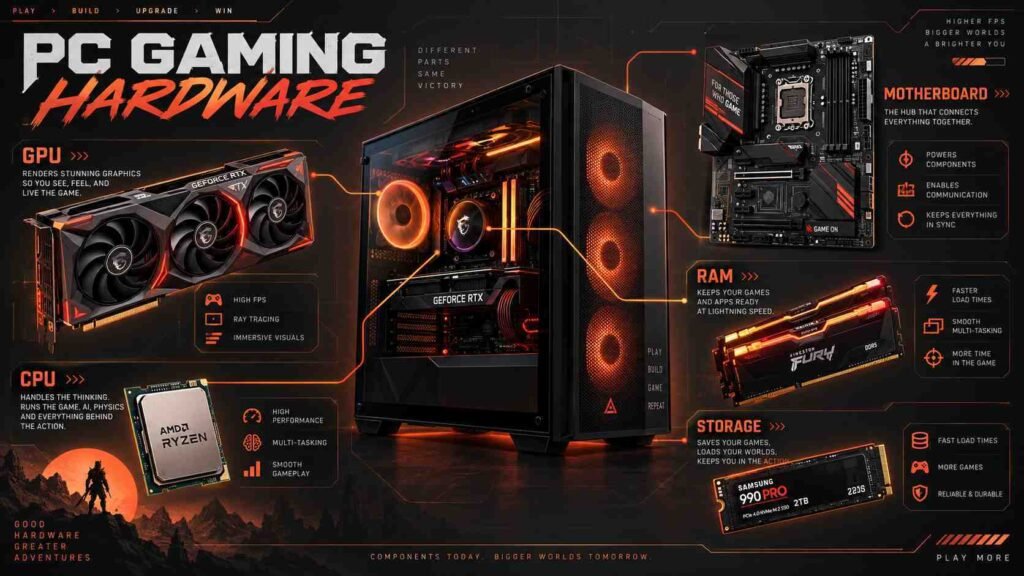
PC Hardware: CPU, GPU, RAM and Storage
PC hardware is one of the most important parts of the gaming experience.
Graphics Card
The GPU has a major influence on gaming performance because it handles much of the graphical workload.
The right GPU depends on factors such as:
- Target resolution
- Desired frame rate
- Graphics settings
- Game requirements
- Monitor refresh rate
- Budget
A graphics card suitable for 1080p gaming may not be the right choice for a system targeting demanding 4K gaming.
Processor
The CPU is another important part of the system.
It can have a particularly noticeable effect in games that are CPU-heavy or when a player is targeting very high frame rates.
However, buying the most expensive processor available is not automatically the best use of a gaming budget.
The CPU needs to make sense alongside the graphics card and the rest of the system.
RAM
Memory affects how comfortably a PC handles games and other applications at the same time.
The amount you need depends on the games and other workloads you run. A gaming PC that is also used for streaming, editing, development, or other demanding applications may have different memory requirements from a machine used almost exclusively for gaming.
Storage
Modern games can require substantial amounts of storage.
An SSD can also improve loading and general system responsiveness compared with older storage technologies.
The practical question is therefore not simply how fast a drive is. You should also consider how much capacity you need and whether there is room for additional storage later.
Choosing a Gaming PC Around Your Games
One of the easiest mistakes when buying a gaming PC is starting with the hardware instead of the games.
Start with your actual library.
A player who mainly plays competitive games may prioritize high frame rates and low latency. Someone who spends most of their time with visually demanding single-player games may place greater emphasis on graphical quality and resolution.
That difference changes the hardware priorities.
Your monitor should also be part of the decision.
A 1080p display, a 1440p monitor, and a 4K screen place very different demands on a gaming PC. A high-refresh display can also make more sense when the computer is capable of producing the frame rates needed to take advantage of it.
The goal is not to build the most powerful PC possible.
The goal is to build a PC that performs well for the games you actually play.
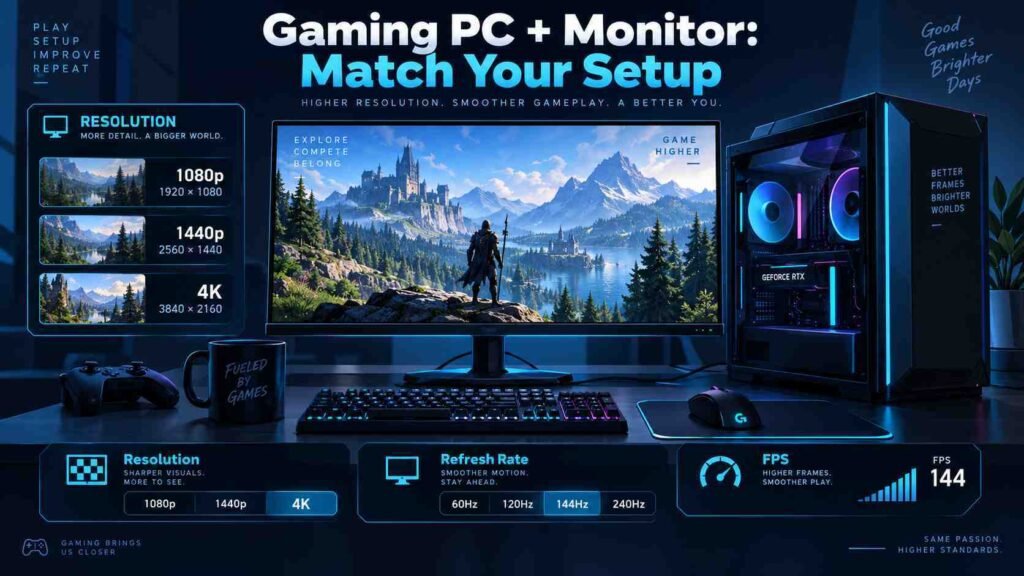
Gaming PC and Monitor: Why They Need to Match
A gaming monitor is not just an accessory.
Resolution determines the number of pixels the GPU has to render. Refresh rate determines how frequently the display can update. Response characteristics and adaptive synchronization can also influence how games feel during fast movement.
This means the monitor should be considered alongside the PC.
For example, there is little benefit in buying an extremely high-refresh display if your system rarely produces enough frames to use it effectively.
Likewise, moving to a higher resolution can increase the graphics workload considerably.
Competitive players may prioritize refresh rate and responsiveness, while players focused on cinematic games may care more about resolution, image quality, and graphical detail.
There is no universally best gaming monitor.
There is only a monitor that fits a particular PC and a particular player’s needs.
Building a Gaming PC vs Buying a Prebuilt
Both approaches can make sense.
Building Your Own PC
Building a PC provides greater control over component selection.
You can decide exactly where the budget goes and select individual parts according to your priorities. It can also teach you how the different components of a computer work together.
The downside is that building requires research.
You need to check compatibility, power requirements, cooling, physical dimensions, BIOS support, connectors, and other details before purchasing the parts.
Buying a Prebuilt
A prebuilt gaming PC is more convenient.
The system is assembled and tested before it reaches the buyer, which can save considerable time.
However, buyers should still check the individual specifications rather than judging a prebuilt only by its headline CPU or GPU.
A system may advertise a powerful graphics card while using less impressive components elsewhere.
The important question is always:
What exactly am I getting for the money?
Don’t Ignore the Upgrade Path
A gaming PC does not have to remain unchanged for years.
One of the advantages of PC gaming is the ability to upgrade individual components.
Depending on the system, you may eventually replace the GPU, add storage, increase memory, improve cooling, or make other changes.
Planning for upgrades before buying can make this process easier.
Check the motherboard’s expansion options, case dimensions, power supply capacity, cooling configuration, and compatibility with future components.
A little planning can prevent a situation where one upgrade creates the need for several additional purchases.
Understanding Gaming Performance
When a game runs poorly, buying new hardware should not always be the first response.
The first step is to find the actual limitation.
Low FPS can be caused by the GPU, CPU, memory, temperatures, drivers, background processes, or game settings.
For example, if the GPU is already operating close to full utilization, lowering certain graphical settings may improve performance.
If the CPU is the bottleneck, reducing visual quality may not make a major difference.
Thermal problems create another possibility.
A system that becomes too hot may reduce its performance to control temperatures. In that situation, improving cooling or airflow could be more useful than replacing a component.
The broader lesson is simple:
Diagnose before you upgrade.
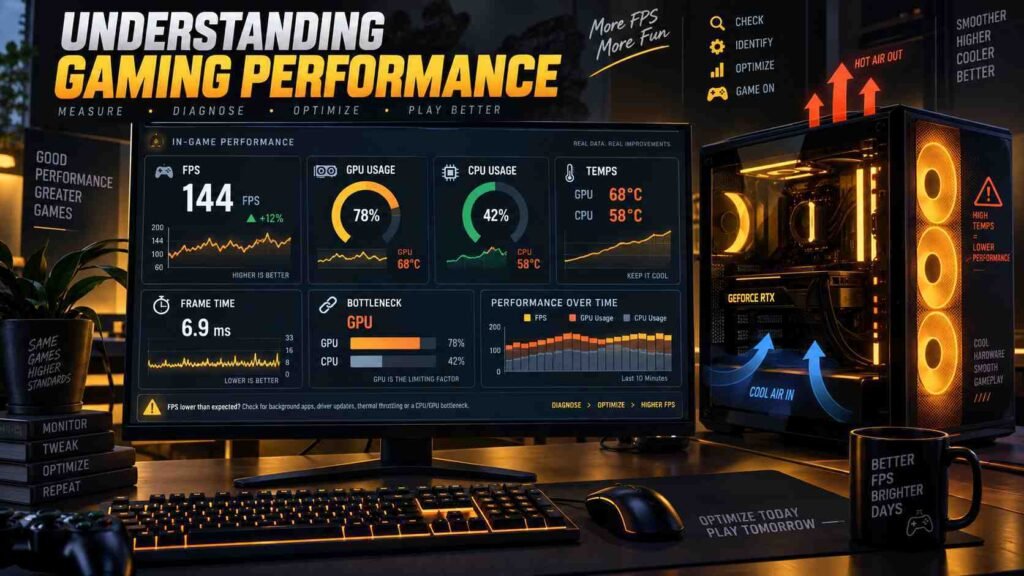
FPS Is Not the Whole Story
Frames per second is one of the most common ways to discuss gaming performance, but it is not the only measurement that matters.
Average FPS tells you how many frames a system produces over a period of time. It does not necessarily describe how consistent the experience feels.
Frame-time consistency, input latency, temperatures, and sudden performance drops can all influence the perceived smoothness of a game.
That is why two systems with similar average FPS can sometimes feel different during actual gameplay.
When troubleshooting performance, look beyond a single number.
Linux Gaming on EuroGamersOnline
Linux gaming is another area covered by EuroGamersOnline.
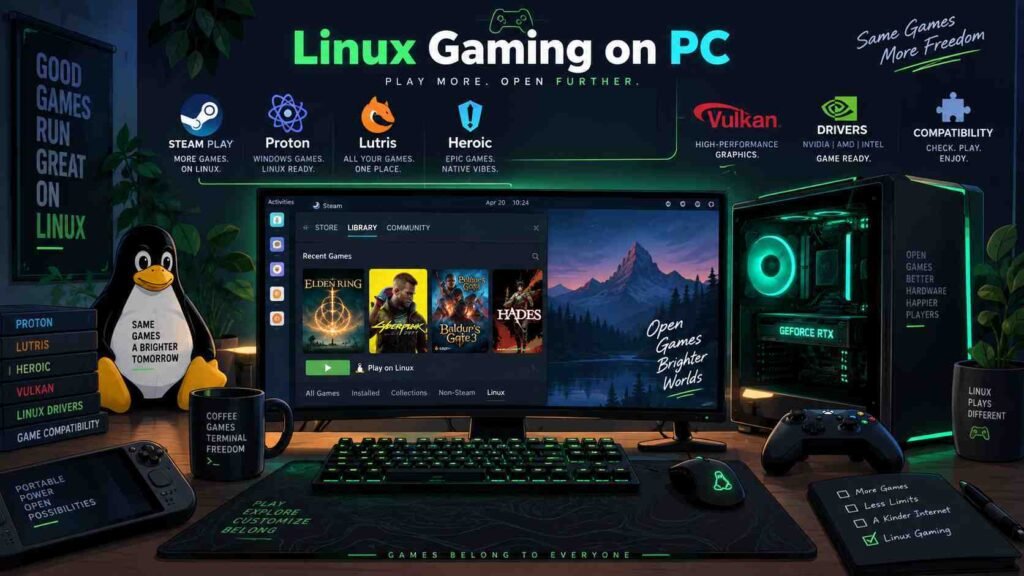
The site’s Linux Gaming PC guide discusses hardware selection, distributions, graphics drivers, Vulkan, Steam Play/Proton, Lutris, Heroic, troubleshooting, and performance tuning.
This is useful because Linux gaming involves considerations that do not always appear in a traditional Windows-focused PC build.
Hardware compatibility matters.
Graphics drivers matter.
The game itself matters too.
Steam Play and Proton can allow many Windows games to run on Linux, while tools such as Lutris and Heroic can help with other launchers and game libraries. The EuroGamersOnline guide also recommends checking compatibility and keeping Proton and Wine versions updated where appropriate.
However, Linux gaming should not be treated as universally identical to Windows gaming.
Compatibility can vary from game to game, particularly when anti-cheat systems, launchers, drivers, or other dependencies are involved.
For anyone considering Linux, checking the games they actually play is more useful than assuming every title will work in exactly the same way.
Who Is EuroGamersOnline PC Gaming For?
The PC Gaming section can be useful to several types of readers.
Beginners
New PC gamers have to learn a surprising amount of terminology.
CPU, GPU, RAM, SSD, motherboard, refresh rate, resolution, drivers, cooling and power supply are only some of the terms that appear during the buying process.
A useful guide should help beginners understand how those specifications relate to their actual gaming needs.
PC Owners Planning an Upgrade
Existing PC owners can also benefit.
Instead of immediately replacing the whole computer, they can investigate whether one component is limiting their performance.
That can potentially turn an expensive replacement into a more targeted upgrade.
Hardware Enthusiasts
More experienced PC users may already understand the basics and instead want information about particular components, configurations, operating systems, or optimization techniques.
The EuroGamersOnline PC Gaming section provides several different hardware-related topics that can serve as starting points for that research.
Linux Gamers
Linux users have their own set of hardware and software considerations.
The dedicated Linux Gaming PC guide makes this a particularly relevant part of the site’s PC coverage.
The Person Behind EuroGamersOnline’s PC Gaming Coverage
The site’s Meet the Crew page identifies Maggy Panes as its PC Gaming-focused member, describing her as someone interested in building gaming systems and analyzing graphics cards and processors.
That is worth mentioning because PC gaming involves a different set of technical considerations from console gaming.
A reader researching hardware, PC builds, or performance naturally benefits from content that understands those differences.
What Should You Check Before Buying PC Hardware?
Before buying any component, check compatibility first.
For a graphics card, consider:
- Case clearance
- Power requirements
- Required connectors
- Power supply capacity
- Intended gaming resolution
For a processor, check:
- Motherboard compatibility
- Socket/platform
- BIOS support where relevant
- Cooling requirements
- Overall system balance
For RAM, consider platform compatibility, capacity, and the needs of the applications you actually use.
For storage, consider both capacity and expansion options.
The same principle applies to monitors.
Do not buy a display simply because it has a higher refresh rate or resolution. Make sure the PC can make meaningful use of those capabilities.
How to Get More Value From PC Gaming Guides
A gaming guide is most useful when you apply its information to your own situation.
Before following a recommendation, write down your current:
- CPU
- GPU
- RAM
- Storage
- Power supply
- Monitor
- Operating system
- Target resolution
- Most-played games
This gives you a baseline.
You can then determine whether you actually need an upgrade or whether a software, settings, driver, or cooling change could solve the problem.
It also prevents you from copying another player’s setup without understanding why that configuration works for them.
There is no universal gaming PC.
A system designed for competitive 1080p gaming can have very different priorities from a workstation-style machine intended for 4K gaming, streaming, editing, and other demanding workloads.
Keep Current Information in Mind
PC hardware changes quickly.
New generations arrive, prices move, drivers are updated, and games receive patches.
As a result, an older buying recommendation may still contain useful information while some of its specific product advice becomes outdated.
That is why readers should use PC Gaming articles as research rather than as a substitute for checking current specifications and prices.
This is particularly important when spending a significant amount of money.
Why EuroGamersOnline PC Gaming Is Worth Exploring
The main value of EuroGamersOnline’s PC Gaming section is the range of topics it brings together.
It covers the PC as a complete gaming platform rather than focusing only on games.
Readers can explore hardware, gaming PCs, performance, optimization, monitors, PC configurations, and Linux gaming. The site’s PC archive includes several hardware and setup-oriented subjects, while the Linux Gaming PC guide provides more detailed coverage for users interested in that operating system.
That makes the section relevant at different stages of the PC gaming journey.
A beginner can learn the terminology.
An existing player can investigate an upgrade.
A hardware enthusiast can compare configurations.
A Linux user can research compatibility and performance.
The key is to use the information in context.
Frequently Asked Questions
What is EuroGamersOnline.com PC Gaming?
EuroGamersOnline.com PC Gaming is the PC-focused section of EuroGamersOnline. It covers gaming PCs, hardware, performance, optimization, PC setups, and other topics related to computer gaming.
What can I find in the EuroGamersOnline PC Gaming section?
You can explore topics related to gaming hardware, PC builds, performance optimization, monitors, processors, graphics cards, Linux gaming, and other aspects of the PC gaming experience.
Does EuroGamersOnline cover PC hardware?
Yes. Its PC Gaming coverage includes hardware-oriented topics such as i7 and i9 gaming PCs, gaming PC bundles, and Linux gaming hardware considerations.
Does EuroGamersOnline cover Linux gaming?
Yes. EuroGamersOnline has a dedicated Linux Gaming PC guide covering hardware, distributions, graphics drivers, Vulkan, Steam Play/Proton, Lutris, Heroic, troubleshooting, and performance tuning.
Is EuroGamersOnline useful for beginners?
It can be a useful starting point for people learning about PC gaming and gaming hardware. Beginners should still verify current prices, specifications, compatibility, and independent performance information before making a major purchase.
Final Thoughts
A good gaming PC is not simply a collection of expensive components.
It is a system built around a purpose.
The games you play, the resolution you want, the monitor you use, your budget, and the upgrades you may want later should all influence your decisions.
That is where EuroGamersOnline.com PC Gaming can be useful. Its PC Gaming section brings together information about gaming PCs, hardware, performance, optimization, and alternative setups such as Linux gaming.
The best way to use that information is to apply it to your own situation.
Don’t choose a component simply because its specifications look impressive. Don’t replace an entire PC before finding the actual performance problem. And don’t assume that another player’s configuration will automatically be right for you.
Start with the games.
Define the experience you want.
Set a realistic budget.
Then build or buy around those requirements.
That approach will help you create a gaming PC that is not merely powerful on paper, but genuinely suited to the way you play.